Hindu Gods Name Generator
Embrace divine avatars with our Hindu god name generator! Create sacred deity names perfect for Eastern fantasy RPG, Indian mythology campaigns, or spiritual stories.
Gender Preference
Generating magical names...
Divine Names for RPG & Storytelling
Sanskrit names carry sacred meaning beyond mere labels. Whether you're building a D&D campaign, developing characters for an Eastern fantasy novel, or exploring Vedic mythology for creative inspiration, understanding Hindu deity naming conventions unlocks a world of narrative depth. Our Hindu god name generator combines authentic linguistic patterns with creative freedom, offering writers and gamers a respectful gateway into one of humanity's oldest spiritual traditions.
Understanding the Power of Vedic Mythology: An Introduction to Hindu Deity Names
Hindu deity names function as compressed mythological narratives. Each syllable, each sound carries embedded spiritual significance rooted in Sanskrit—a language where phonetic vibration matters as much as semantic meaning.
Take Krishna, for instance. The name derives from the Sanskrit root kṛṣ-, meaning "to pull" or "to attract," reflecting the deity's magnetic charm and divine love. Lakshmi, goddess of wealth, connects to lakṣ-, meaning "goal" or "aim," embodying prosperity as life's ultimate objective. These aren't arbitrary choices. Ancient texts like the Vedas (Rigveda, Samaveda, Yajurveda, Atharvaveda) and later scriptures such as the Puranas and Upanishads established naming patterns that reveal cosmic principles.
What makes Hindu naming traditions unique is their scope. The tradition encompasses approximately 33 million deities—not literal individual gods, but manifestations of ultimate reality (Brahman) across infinite aspects of existence. This vast pantheon means every human experience, natural phenomenon, and abstract concept has divine representation. Ganesha guards new beginnings, Saraswati governs knowledge and arts, and Hanuman embodies devotion and strength.
For storytellers and game designers, this creates unprecedented creative opportunities. Need a deity of thunderstorms? Indra commands lightning and rain. Crafting a character connected to justice and the afterlife? Yama judges souls and maintains cosmic order. The mythology provides ready-made narrative frameworks spanning creation myths (Brahma), preservation tales (Vishnu), and transformation cycles (Shiva).
How the Hindu God Name Generator Works for RPGs, D&D, and Storytelling
Our AI-powered generator analyzes authentic Sanskrit linguistic patterns to create original deity names suitable for fantasy contexts. Unlike random name generators, it incorporates actual etymological structures found in Vedic texts, ensuring phonetic authenticity while avoiding direct copying of sacred names.
The system offers several customization options:
Gender Preference: Select Male, Female, or Any to generate names matching your character concept. Male options reflect patterns seen in names like Vishnu, Shiva, and Rama. Female selections mirror goddess names such as Durga, Parvati, and Gayatri.
Name Length: Choose Short (1-2 syllables), Medium (3-4 syllables), or Long (5+ syllables). Shorter names like "Dev" or "Kali" work well for direct, powerful characters. Longer names such as "Narasimha" (Vishnu's man-lion avatar) or "Bhuvaneshvari" (ruler of the universe, an epithet for the goddess) carry more elaborate meaning.
Syllable Count: Specify exactly how many syllables you need (1, 2, 3, 4+). This helps maintain consistency across a pantheon or match metrical requirements in poetry and prose.
Prefix and Suffix Filters: Use "Starts With" and "Ends With" fields to incorporate meaningful elements. Common prefixes include "Dev-" (divine), "Maha-" (great), or "Sri-" (radiant). Popular suffixes include "-esh" (lord), "-ani" (feminine ending), or "-aya" (variations meaning "born of" or "belonging to").
Each generation produces six unique names. Click as many times as needed until you find the perfect match. The tool balances creative freedom with cultural respect—these are original creations inspired by traditional patterns, not direct reproductions of deities actively worshipped by over one billion Hindus worldwide.
The Psychological Architecture of Sanskrit Names: More Than Just Labels
Sanskrit operates on the principle that sound shapes reality. This isn't mysticism—it's linguistic philosophy embedded in how names function within Hindu tradition.
The language uses compound formation (called samāsa) to build complex meanings from simple roots. The dvandva compound treats multiple elements as equally important, joined conceptually by "and." For example, a name combining "light" and "wisdom" elements gives equal weight to both qualities.
The tatpurusha compound emphasizes the final element, with preceding words serving as modifiers. A hypothetical deity name meaning "holder of the lotus" would prioritize "holder" while "lotus" adds specific detail—useful for defining a character's primary attribute with supporting imagery.
Names often describe function rather than fixed identity. Vishnu means "the pervader," reflecting his role as cosmic preserver present in all things. Shiva translates to "the auspicious one," emphasizing his benevolent aspect despite being the destroyer. Saraswati derives from saras (flow) and vati (she who has), capturing her association with flowing rivers, flowing knowledge, and flowing music.
For character development, this means names can encode:
- Primary domains: What cosmic principle does this character embody?
- Personality traits: Which virtues or qualities define them?
- Narrative function: What role do they play in your story's cosmology?
- Visual symbolism: What imagery should audiences associate with them?
Understanding these layers transforms name selection from an aesthetic choice to a narrative tool. When you name a character, you're establishing their conceptual DNA.
The Trimurti and Tridevi: Foundational Cosmic Blueprints for Character Design
The Trimurti ("Three Forms") represents Hinduism's cosmic operating system through three primary functions, each managed by a distinct deity. According to the Encyclopaedia Britannica, this concept emerged by at least the 4th–5th century CE in texts like Kalidasa's Kumarasambhava.
Brahma, the Creator, initiates existence. Depicted with four heads symbolizing comprehensive knowledge and four arms holding sacred texts and ritual implements, Brahma represents the generative force. Despite his cosmic importance, he rarely receives worship—Puranic stories suggest moral lapses cost him devotees, and he's described as merely executing creation under direction from Vishnu or Shiva. For storytelling, Brahma offers templates for ambitious creators whose initial vision doesn't guarantee lasting reverence.
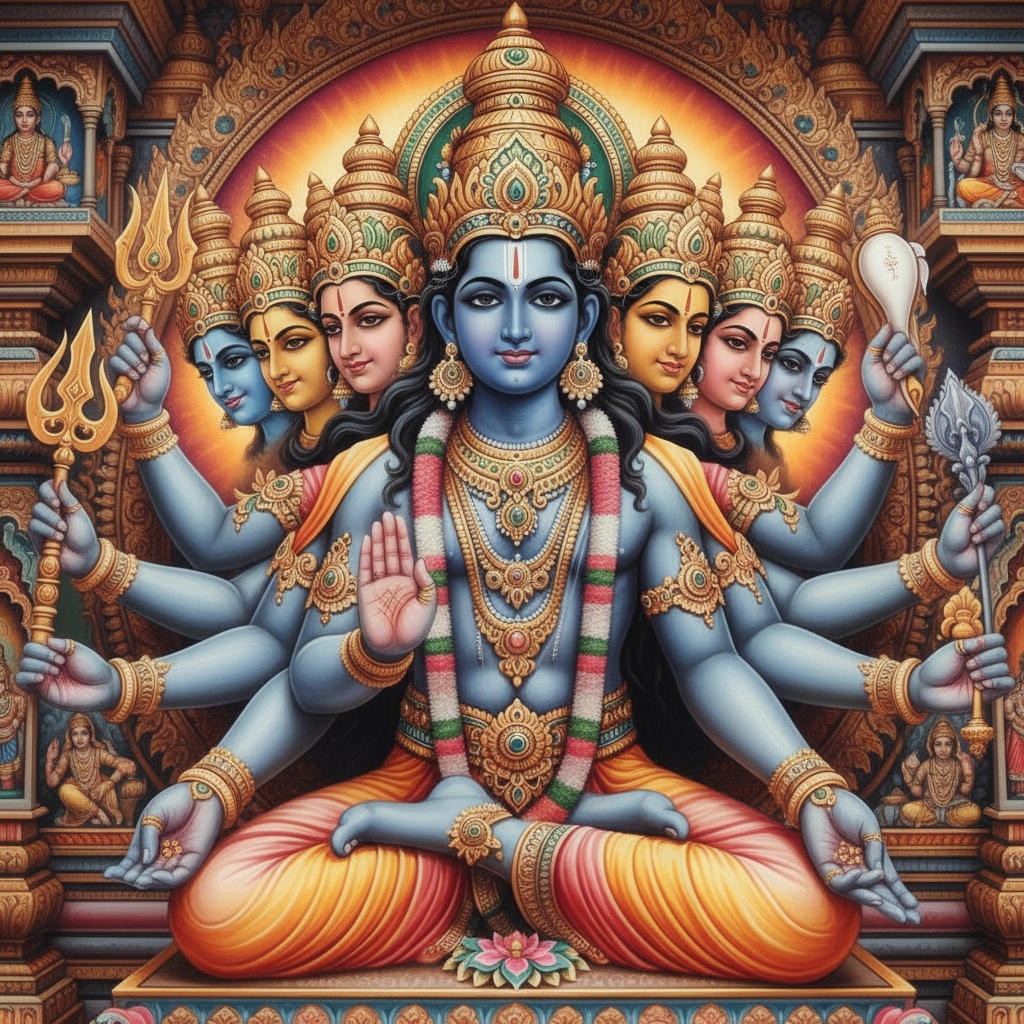
Vishnu, the Preserver, maintains cosmic order. His four arms hold the conch shell (primordial sound), discus (mind/time), mace (strength), and lotus (creation/purity). Vishnu intervenes when dharma (cosmic order) weakens, descending through avatars to restore balance. This character archetype works for protagonists who protect what exists rather than build anew or tear down—defenders of tradition, maintainers of peace, guardians of the status quo.
Shiva the Destroyer transforms through destruction. Holding his trident and often depicted with a third eye and a serpent around his neck, Shiva represents endings that enable new beginnings. He's simultaneously an ascetic meditator and a cosmic dancer (Nataraja), embodying paradox. This duality makes Shiva-inspired characters ideal for exploring themes of necessary loss, creative destruction, and transformation through crisis.
The Tridevi mirrors this trinity through feminine divine power (Shakti). While the Trimurti focuses on cosmic functions, the Tridevi emphasizes active energy that makes those functions possible.
Saraswati, consort of Brahma, governs knowledge, arts, and music. Depicted holding manuscripts and the veena (stringed instrument), often accompanied by a white swan, she personifies intellectual and creative pursuit. Characters based on Saraswati excel as scholars, artists, musicians, or keepers of sacred wisdom.
Lakshmi, wife of Vishnu, embodies wealth, prosperity, and abundance. Seated on a lotus with gold coins sometimes falling from her hand, she represents material and spiritual fortune. Lakshmi-type characters can serve as patrons, benefactors, or symbols of what's worth preserving—though her association with the white owl Uluka suggests wisdom in wealth's acquisition and use.
Parvati, Shiva's consort, channels devotion, love, and fertility. As the benevolent aspect of the goddess (contrasting with her fierce forms, Durga and Kali), Parvati represents the power of love and dedication. Her name literally means "daughter of the mountain," connecting her to earthly foundations and enduring strength.
These six deities provide archetypal frameworks for any pantheon: creation/knowledge, preservation/wealth, destruction/devotion, each paired with complementary energies. Mix and match their attributes when building divine characters for your world.
Exploring the Dashavatara: Using Vishnu's Incarnations as Narrative Inspiration
According to Britannica's Dashavatara entry (last updated May 23, 2025), Vishnu descends to Earth in ten primary avatars to restore cosmic order whenever righteousness declines. Each incarnation offers distinct narrative possibilities.
- Matsya (Fish): Saves knowledge and creatures during a cosmic flood, guiding the first man, Manu, to safety. Use this template for savior characters who preserve civilization during cataclysmic events.
- Kurma (Tortoise): Bears the weight of Mount Mandara during the churning of the Ocean of Milk, enabling gods and demons to obtain nectar of immortality. Ideal for supporting characters whose unseen labor makes epic achievements possible.
- Varaha (Boar): Rescues Earth from the demon Hiranyaksha, who dragged her to the ocean's depths. Works for heroic rescuer archetypes battling forces that would bury or hide the truth.
- Narasimha (Man-Lion): Defeats the demon Hiranyakashipu through creative interpretation—emerging at twilight (neither day nor night) from a pillar (neither indoors nor outdoors) to attack on his lap (neither ground nor sky). Perfect for trickster heroes who exploit loopholes in seemingly unbeatable magical contracts.
- Vamana (Dwarf): Appears as a humble dwarf to trick the demon king Bali, then grows to cosmic size to reclaim the three worlds. Useful for characters whose true power remains hidden until the critical moment.
- Parashurama (Rama with the Axe): Wages a campaign to cleanse the world of corrupt warriors. Represents necessary violence against systemic oppression—controversial, morally complex, potentially immortal.
- Rama: The ideal king and hero of the Ramayana, embodying virtue and righteous conduct in his quest to rescue his wife Sita from the demon king Ravana. The archetypal noble protagonist.
- Krishna: Divine playfulness, romantic love, and strategic wisdom combined. Central to the Mahabharata and the Bhagavad Gita, Krishna serves as charioteer, advisor, lover, and cosmic revealer. Offers templates for charismatic leaders whose charm masks profound depth.
- Buddha: Included by some traditions (first documented in the Gupta empire, 4th–6th century CE) as a reformer of religious practice. Shows how traditions incorporate and reframe other spiritual movements.
- Kalki: The future avatar yet to appear, riding a white horse with a drawn sword to end the current age of darkness (Kali Yuga) and initiate renewal. The prophesied savior archetype for apocalyptic narratives.
Note that avatar lists vary across regions and sects, with some traditions counting Balarama (Krishna's brother) as the eighth avatar and Krishna as the ninth. This flexibility demonstrates how mythological frameworks adapt to local needs—valuable insight when building your own pantheon.
Each avatar responds to specific types of threats (natural disaster, cosmic imbalance, demonic oppression, systemic corruption, moral degradation). When designing divine characters or prophesied heroes, consider which existential challenge they address and let that shape their abilities, personality, and methods.
Cultural Significance and Respectful Use of Sacred Names in Modern Media
Using Hindu deity names in games, novels, and creative projects requires cultural awareness. These aren't just fantasy elements—they're active components of a living religion practiced by over one billion people globally.
The Hindu American Foundation's media toolkit (copyright 2003–2025) provides clear guidance for respectful representation:
Terminology Matters: Use "murti" instead of "idol" when referring to deity representations. "Idol" carries Abrahamic connotations of false gods, while "murti" means embodiment or sacred presence. Describe Ganesha as "the elephant-headed god who removes obstacles" rather than "the elephant god"—emphasizing function over form avoids reducing complex deities to animal associations.
Avoid Stereotypes: Don't conflate Hinduism with generic "Eastern mysticism" or treat it as an unchanging ancient tradition. The faith has evolved continuously over at least five millennia. Don't describe the Shiva lingam as a phallic symbol—it represents the infinite, formless nature of ultimate reality. Don't claim Hindus worship cows as deities (though the cow is respected as a symbol of selfless service and non-violence).
Context Over Caricature: If incorporating Hindu philosophical concepts like karma, dharma, or moksha, represent them accurately. Karma isn't luck or fate—it's the principle of action and consequence. Dharma means cosmic order and moral duty, not merely "destiny."
Commercial Use Guidelines: The Hindu American Foundation specifies that deity images should never appear on items intended to be stepped on (footwear, bathmats, rugs), products associated with bodily waste (toilet seats), or objects likely to be destroyed through normal use (napkins placed where images will touch mouths or be discarded). Images on clothing worn on the upper body (shirts, shawls), decorative items (wall hangings), or vegetarian food products are generally acceptable.
For name generators and fictional characters, the key principle is inspiration rather than appropriation. Our generator creates original names following authentic Sanskrit patterns—it doesn't reproduce the actual names of worshipped deities like Vishnu, Shiva, or Lakshmi. This approach honors the tradition while maintaining creative freedom.
When using generated names:
- Treat divine characters with narrative dignity appropriate to cosmic entities
- Research the concepts you're drawing from to avoid misrepresentation
- If adapting actual mythological stories (Ramayana, Mahabharata), acknowledge the source
- Consider whether your portrayal might reinforce harmful stereotypes
- Remember that what seems like fantasy worldbuilding to some audiences represents sacred heritage to others
Think of Hindu mythology as you would Greek or Norse traditions—rich narrative resources that deserve accurate representation rather than surface-level exoticism.
Embracing Sacred Archetypes in Your Creative Work
Hindu deity names offer more than an exotic flavor for fantasy settings. They provide access to millennia of refined storytelling about creation, preservation, destruction, knowledge, wealth, power, devotion, and transformation.
Our generator serves as your entry point into this vast tradition. Each name it produces carries echoes of Sanskrit's phonetic architecture, where sound and meaning intertwine. Use these names to build pantheons with genuine mythological depth, create characters whose appellations reflect their cosmic roles, or simply find inspiration in traditions that have shaped spiritual thought across Asia and beyond.
The key is approaching this resource with curiosity and respect. Study the deities, read the epics (even in summary), and understand the principles. Let the mythology inform your worldbuilding rather than serving as decorative dressing. When you name a character after patterns found in Vedic tradition, you're connecting your story to one of humanity's oldest continuous cultural lineages.
Generate names, research their inspirations, build your worlds, and honor the traditions that make this creative work possible.
Frequently Asked Questions
How does the Hindu Gods Name Generator work?
Our AI-powered generator analyzes authentic Sanskrit linguistic patterns and Vedic naming conventions to create original deity names. It produces six unique names per generation, drawing from root words, compound structures, and phonetic patterns found in Hindu scripture while avoiding direct reproduction of actively worshipped deity names. Advanced filters allow customization by gender, length, syllable count, and prefix/suffix elements.
Can I use generated names in commercial projects?
Yes. Generated names are original creations free for use in commercial or personal projects, including published novels, video games, tabletop RPG campaigns, and other creative works. Since names cannot be copyrighted and our generator produces unique combinations inspired by (not copied from) traditional sources, no attribution is required. However, ensure your overall portrayal of Hindu-inspired elements remains respectful and culturally informed.
What's the difference between using real deity names versus generated ones?
Real deity names like Vishnu, Shiva, Lakshmi, and Ganesha carry deep religious significance for over one billion Hindus worldwide. Using actual worshipped deity names risks cultural insensitivity or misrepresentation. Our generator creates original names following authentic Sanskrit patterns, offering creative freedom while respecting living religious traditions. Think of it as the difference between naming a character "Zeus" versus "Zeusian-inspired name."
How do I make sure my use of Hindu-inspired names is culturally respectful?
Research the concepts you're drawing from, avoid reducing deities to exotic stereotypes, and treat divine characters with appropriate narrative dignity. Don't portray Hindu concepts (karma, dharma, reincarnation) as superficial plot devices without understanding their actual meaning. The Hindu American Foundation recommends using proper terminology (murti instead of idol, describing deities by function rather than animal associations) and avoiding commercial use on items meant to be stepped on or discarded.
What are the Trimurti, and why do they matter for character design?
The Trimurti consists of Brahma (creator), Vishnu (preserver), and Shiva (destroyer)—three cosmic functions that maintain universal balance. These archetypes provide foundational templates for divine characters: initiators who start things, maintainers who protect what exists, and transformers who enable renewal through endings. Understanding these roles helps you build coherent pantheons where deities serve distinct narrative purposes rather than being interchangeable magical entities.
Can I combine elements from different Hindu deities in one character?
Yes, with cultural awareness. Hindu tradition itself features composite forms (like Harihara, combining Vishnu and Shiva, or Ardhanarishvara, Shiva as half-male, half-female). When creating original characters, you can blend attributes—a knowledge deity with warrior aspects, or a wealth goddess who also governs transformation. Just ensure combinations make thematic sense and don't trivialize the source concepts. Research similar combinations in actual mythology for guidance.
What should I know about Sanskrit naming conventions?
Sanskrit uses compound formation where multiple word elements combine to create complex meanings. The order and type of compound matter: some emphasize the final element, others treat all parts equally. Names often describe function (Vishnu means "pervader"), embody qualities (Shiva means "auspicious"), or connect to visual symbols (Padma/Kamala for Lakshmi references her lotus seat). Phonetic vibration carries significance—sounds aren't arbitrary but chosen for their spiritual resonance.
Are the Dashavatara useful for creating hero archetypes?
Absolutely. Vishnu's ten avatars (Matsya, Kurma, Varaha, Narasimha, Vamana, Parashurama, Rama, Krishna, Buddha, Kalki) each respond to different existential threats with distinct approaches—from subtle trickery (Vamana) to confrontation (Narasimha) to moral exemplar (Rama) to charismatic strategist (Krishna). These provide ready-made templates for heroic characters, especially prophesied saviors, chosen ones, or divine interventions in your narrative. Each avatar shows how the same cosmic principle adapts its methods to different challenges.
How do goddess names differ from god names in structure?
Goddess names often end in feminine suffixes like -ī, -ā, or -āni (Sarasvatī, Pārvatī, Durgā), though not universally. Many goddess names reference natural elements (Sarasvatī from rivers, Pārvatī from mountains), marital relationships (Gauṛī as consort of Śiva), or abstract qualities (Lakṣmī from prosperity). Feminine divine names may also incorporate epithets describing fierce (Kāli) versus benevolent (Pārvati) aspects of the same goddess, reflecting Hinduism's complex understanding of divine feminine power (śakti).
Is this generator appropriate for religious or devotional purposes?
No. This tool is designed for creative, educational, and entertainment purposes—fantasy gaming, fiction writing, and worldbuilding. For religious, spiritual, or devotional contexts, consult authentic scriptures (Vedas, Puranas, Upanishads), Sanskrit scholars, or Hindu religious authorities. The generated names are original creations inspired by linguistic patterns, not traditionally significant appellations suitable for worship or ceremonial use.