Roman Gods Name Generator
Command imperial pantheons with our Roman god name generator! Generate classical deity names ideal for historical RPG, Heroes of Olympus campaigns, or ancient Rome settings.
Gender Preference
Generating magical names...
Create Authentic Deity Names
The ancient Romans didn't just borrow their gods wholesale from the Greeks—they forged something distinctly their own. Etruscan influences shaped the earliest Roman pantheon, creating deities with characteristics that reflected the values of a civilization destined to rule the Mediterranean. From Jupiter's thunderous authority to Vesta's quiet guardianship of the hearth, Roman mythology offered divine figures who embodied everything from martial conquest to domestic harmony.
Understanding Roman god names means grasping how the Romans themselves thought about power, identity, and the sacred. Their naming conventions weren't arbitrary. Each deity's title carried weight, function, and meaning compressed into syllables that worshippers could invoke in moments of crisis or celebration. Mars Ultor—Mars the Avenger—wasn't simply Mars; the epithet transformed the god of war into a specific divine force bent on retribution.
This guide explores the rich naming traditions of Roman mythology, examining major deities like Jupiter and Juno alongside lesser-known figures such as Nemestrinus and Decima. Whether you're crafting characters for tabletop RPGs, writing historical fiction, or building fantasy worlds inspired by ancient Rome, understanding these naming patterns will help you create authentic deity names that resonate with mythological weight.
The Foundation of Roman Divine Names
Roman religious practice operated on a principle called do ut des—"I give that you might give." This contractual relationship between mortals and immortals shaped everything about Roman worship, including how gods received their names. Unlike Greek mythology's elaborate narrative cycles, Roman religion emphasized practical function over storytelling. Names reflected roles, jurisdictions, and the specific ways humans could interact with divine power.
The earliest Roman deities emerged from animistic traditions where spirits inhabited natural phenomena. The hearth fire wasn't just useful for cooking—it embodied the family's continuity and prosperity. When the Romans personified these forces as gods, they created names that made the abstract tangible. Vesta, goddess of the hearth, received her name from roots meaning "dwelling" or "standing." Her very identity declared her function: she was the stable center around which domestic life revolved.
Etruscan culture profoundly influenced early Roman religion, particularly through practices like augury and haruspicy (divination through bird flight and animal entrails). The Etruscans contributed deities like Tinia, Uni, and Minerva, who transformed into Jupiter, Juno, and Minerva within the Roman context. This cultural exchange wasn't simple copying—it represented adaptation, with Roman characteristics layered onto borrowed concepts.
Greek influence arrived later but proved transformative. As Rome expanded across the Italian peninsula and encountered Greek colonies, it adopted the Greek pantheon through interpretatio graeca—identifying Roman gods with Greek equivalents. Mars became associated with Ares, Neptune with Poseidon, and Venus with Aphrodite. Yet crucial differences remained. Mars held far greater prestige in Rome than Ares enjoyed in Greece, reflecting Roman militarism. The Romans didn't just rename Greek gods; they remade them to serve Roman values.
The Structure of Divine Names and Epithets
Roman gods rarely went by single names. Like Roman citizens with their tria nomina (three names: praenomen, nomen, cognomen), deities accumulated epithets that specified their functions, locations, or characteristics. Jupiter wasn't just Jupiter—he was Jupiter Optimus Maximus (Best and Greatest), Jupiter Capitolinus (of the Capitoline Hill), Jupiter Pluvius (Rain-Bringer), and dozens more variations depending on context.
These epithets served practical purposes. When making an offering, Romans needed to address the correct aspect of a deity. Juno Lucina ("She Who Brings to Light") governed childbirth, while Juno Moneta ("She Who Warns") protected Rome's mint and treasury. Calling on the wrong aspect might render your petition ineffective or even offensive. The specificity of Roman divine names reflected a religious system that valued precision.
Mars provides an excellent example of epithet complexity. As Mars Gradivus, he led armies into battle. As Mars Quirinus, he represented the peaceful Roman people. As Mars Ultor—dedicated by Augustus in 2 BC at the Temple of Mars Ultor—he embodied vengeance, particularly the vengeance Augustus claimed for Julius Caesar's assassination at the Battle of Philippi in 42 BC. Each epithet transformed Mars into a distinct divine force appropriate for different circumstances.
Female deities operated under similar naming conventions. Diana appeared as Diana Nemorensis (of the Grove) at Lake Nemi, Diana Lucina (of childbirth) in her protective capacity, and Diana Trivia (of the crossroads) in her more mysterious, witchcraft-associated role. The goddess's power remained constant, but her specific manifestation shifted based on the epithet invoked.
Some epithets are derived from locations where deities received particularly important worship. Juno Regina ("Queen Juno") originally belonged to the Etruscan city of Veii but transferred to Rome after Furius Camillus conquered that city in 392 BC. Roman generals often promised to "transfer" enemy deities to Rome, offering them better temples and more generous sacrifices. This practice, called evocatio, turned divine names into tools of imperial expansion.
The Major Pantheon: Capitoline Triad and Beyond
The Capitoline Triad—Jupiter, Juno, and Minerva—occupied Rome's most sacred space atop the Capitoline Hill. Their temple, dedicated in 509 BC according to tradition, symbolized Roman religious and political unity. Jupiter held the central position as king of the gods and patron of the Roman state. Juno, his wife and sister, governed women's lives, marriage, and childbirth. Minerva, daughter of Jupiter, embodied wisdom, strategic warfare, and handicrafts.
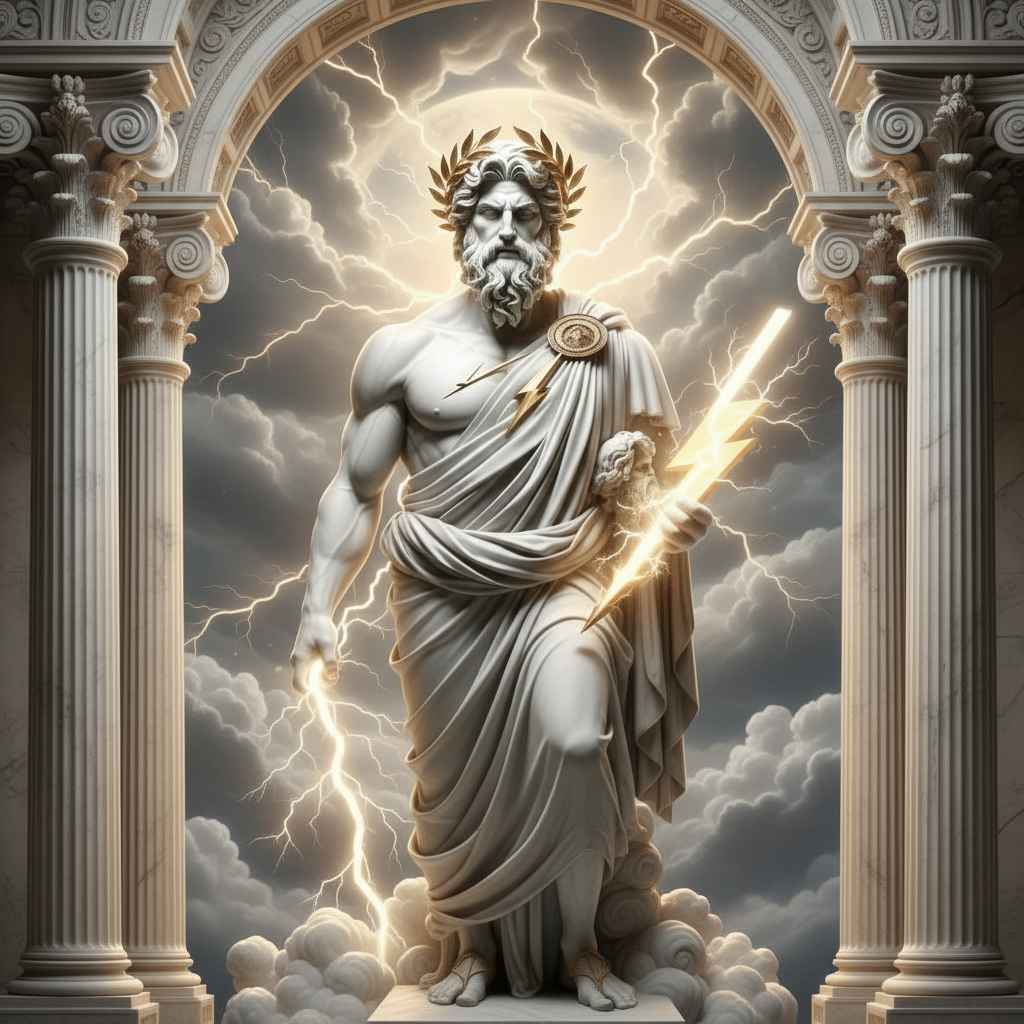
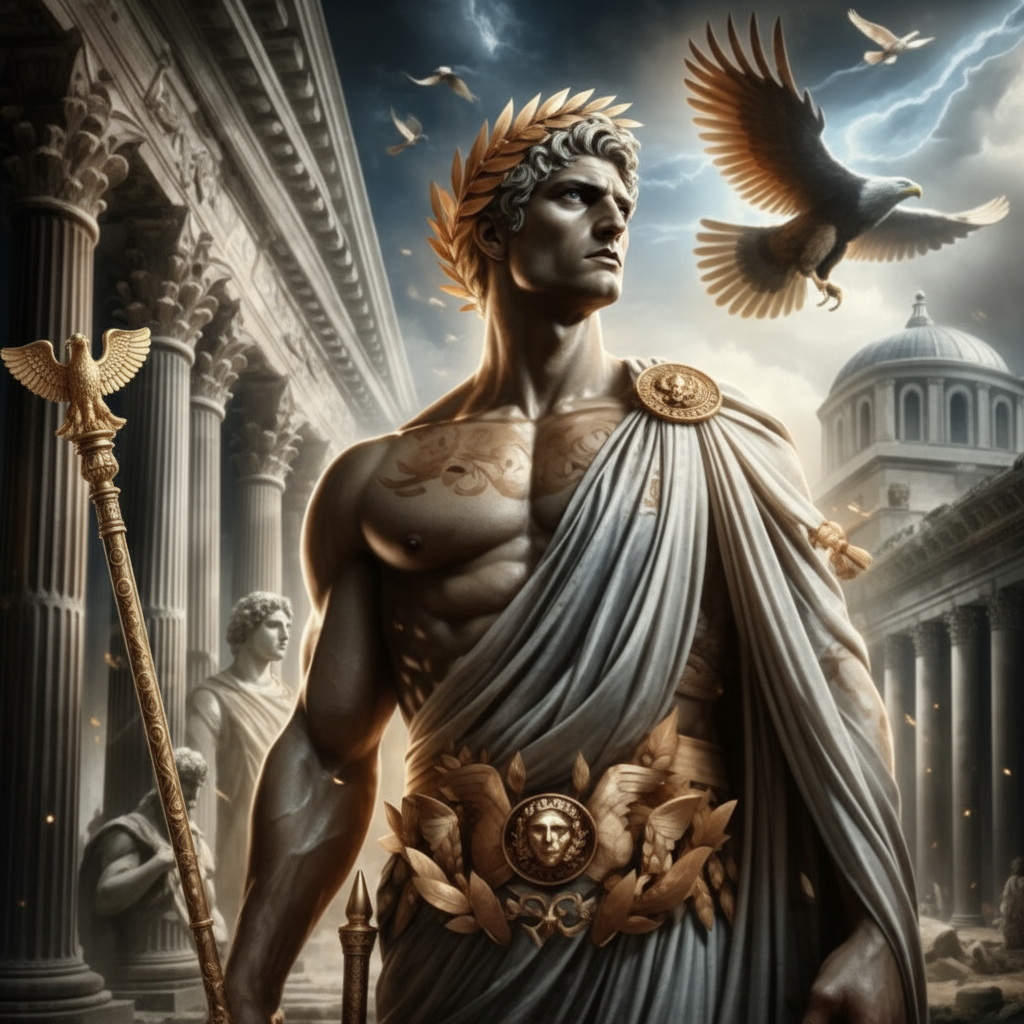
Jupiter (equivalent to Greek Zeus) commanded the sky, thunder, and lightning. His name derives from the Indo-European root *dyeu-, meaning "to shine" or "sky," also found in Greek Zeus and Sanskrit Dyaus. Romans addressed him as Jupiter Optimus Maximus in formal state cult, acknowledging his supreme authority. Every Roman general campaigning abroad first sought Jupiter's approval through augury, and victorious commanders dedicated laurel wreaths at his temple. The eagle—king of birds—served as his sacred animal, symbolizing divine authority and military power.
Juno (Greek Hera) protected Roman women through every life stage. As Juno Lucina, she assisted in childbirth, easing the "bringing to light" of newborns. As Juno Iugalis, she presided over marriage ceremonies. Her name likely connects to roots meaning "youth" or "vital force," reflecting her role as guardian of female life energy. The peacock accompanied her imagery, representing beauty and watchfulness. Roman matrons celebrated the Matronalia festival on March 1st in her honor, with husbands presenting gifts to wives.
Minerva (Greek Athena) governed intellectual pursuits, strategic warfare, and skilled crafts. Unlike Mars's brutal combat, Minerva represented disciplined military planning. Her name may derive from Etruscan Menrva, though Romans associated it with Latin mens (mind). Artisans, physicians, teachers, and poets all claimed Minerva as patron. Her festival, the Quinquatria, occurred in March and featured gladiatorial games and offerings from craftspeople.
Mars ranked second only to Jupiter in Roman religious hierarchy—far more prominent than his Greek counterpart Ares. As father of Romulus and Remus (through the Vestal Virgin Rhea Silvia), Mars claimed direct ancestry over Rome itself. His name possibly derives from roots meaning "shining" or "young man," connecting him to male vitality and agricultural fertility as well as warfare. March, named for Mars, marked the beginning of the Roman military campaign season. Romans honored him with the October Horse sacrifice, where the winning chariot horse from a race was killed, and its tail rushed to the Regia to drip blood on the sacred hearth.
Venus (Greek Aphrodite) embodied love, beauty, and fertility, butthe Romans added a crucial political dimension. Julius Caesar claimed descent from Venus through her son Aeneas, making her the patron goddess of the Julian family. This transformed Venus from a purely personal deity to an imperial symbol. Her temple Venus Genetrix ("Venus the Mother") in Caesar's forum emphasized dynastic legitimacy. The name Venus connects to Latin venus (charm, desire) and the verb venerari (to worship, revere). Roses, doves, and myrtle trees accompanied her cult.
Neptune (Greek Poseidon) ruled the seas and fresh water. His name likely derives from roots meaning "to flow" or "moist." Romans celebrated the Neptunalia festival during July's hottest days, building temporary shelters of branches near water sources. While less central to Roman religion than his Greek equivalent, Neptune received significant attention from sailors and those dependent on water for agriculture or trade.
Specialized Deities and Their Domains
Beyond the major gods, Roman religion featured hundreds of specialized deities governing specific activities, moments, or locations. This theological granularity reflected Roman practicality—every significant action or object had its divine overseer.
Vesta (Greek Hestia) embodied the sacred hearth fire that burned perpetually in her circular temple in the Roman Forum. Her name derives from roots meaning "dwelling" or "to remain." The six Vestal Virgins maintained Vesta's flame, their virginity symbolizing the purity and continuity of Roman religious practice. If the fire went out, Romans interpreted it as a catastrophic omen threatening the state's survival. The Vestalia festival (June 7-15) opened Vesta's sanctuary to matrons who entered barefoot, bringing offerings. Vesta received no anthropomorphic statues—the flame itself represented her divine presence.
Mercury (Greek Hermes) served as messenger of the gods, patron of merchants, travelers, and thieves. His name connects to Latin merx (merchandise) and mercari (to trade). Romans celebrated the Mercuralia festival on May 15th, when merchants sprinkled their heads and merchandise with water from Mercury's sacred spring near the Porta Capena. His distinctive winged sandals and caduceus (staff entwined with serpents) marked him as mediator between divine and mortal realms.
Bacchus (Greek Dionysus) presided over wine, ecstasy, and liberation from social norms. While Greek Dionysian worship emphasized theatrical performance and civic festivals, Roman Bacchic cult initially spread as a mystery religion with secret nocturnal rites. The Senate suppressed these Bacchanalia celebrations in 186 BC, viewing them as threats to social order. The name Bacchus derives from Greek bakchos (frenzied), reflecting the god's association with intoxication and divine madness.
Ceres (Greek Demeter) governed grain, agriculture, and maternal bonds. Her name connects to Latin crescere (to grow). The Cerealia festival in April featured chariot races and the peculiar ritual of tying burning torches to foxes' tails, driving them through the Circus Maximus—possibly representing crop pests destroyed by fire. Roman plebeians particularly honored Ceres, associating her with their political struggles against patrician authority.
Vulcan (Greek Hephaestus) ruled fire, metalworking, and volcanic activity. His name's etymology remains uncertain but may connect to Cretan or Etruscan roots. The Volcanalia festival on August 23rd occurred during the dry season's peak fire danger, with offerings intended to prevent destructive conflagrations. Vulcan received worship at the base of the Capitoline Hill, safely outside the city proper, to contain his dangerous elemental power.
Diana (Greek Artemis) protected wild animals, wilderness, childbirth, and the moon. Her name possibly derives from roots meaning "heavenly" or "divine." While sharing many characteristics with Artemis, Diana developed distinctly Roman cult practices. At her sanctuary near Lake Nemi, enslaved people who killed the reigning "King of the Wood" (the sanctuary's priest) could claim that position—a ritual reflecting older, darker religious traditions. The Nemoralia festival in August celebrated Diana with processions of women bearing torches.
Minor deities filled nearly every conceivable niche. Faunus protected flocks and forests. Pomona governed fruit trees and orchards. Flora brought spring blossoms. Terminus marked boundaries, his stone markers considered sacred and immovable. Janus, unique to Roman religion with no Greek equivalent, presided over beginnings, transitions, and doorways—his two faces simultaneously viewing past and future. January bears his name as the month of beginnings.
Linguistic Patterns in Roman Divine Names
Roman god names follow identifiable phonetic and morphological patterns rooted in Latin and older Italic languages. Understanding these patterns helps create authentic-sounding deity names for creative projects.
Gender markers: Male deity names typically end in -us (Jupiter, Janus, Romulus, Silvanus), -er (Liber), or -o (Pluto, Vulcan). Female names commonly end in -a (Juno, Venus, Diana, Minerva, Vesta) or occasionally -is (Iris, Cybele). These endings correspond to Latin's grammatical gender declensions.
Syllable structure: Most Roman god names contain 2-3 syllables. Single-syllable divine names are rare (Mars being the notable exception). Four-syllable names like Proserpina (queen of the underworld) appear less frequently. This syllabic economy made names memorable and invocable in ritual contexts where precise pronunciation mattered.
Consonant clusters: Latin phonology favored certain consonant combinations. Initial clusters like fl- (Flora), cl- (Clavina), and tr- (Trivia) appear regularly. The letters J and V function as consonantal versions of I and U, so Jupiter originally sounded like "Iuppiter" and Venus like "Wenas." Hard C (always pronounced /k/) and hard G dominated—there's no soft "j" sound in classical Latin pronunciation.
Etymological roots: Many divine names derive from Indo-European roots shared across multiple ancient languages. Neptune shares roots with Sanskrit napat- (water, moisture). Diana connects to *dyeu- (to shine), the same root as Jupiter. Recognizing these deep linguistic connections reveals how Roman religion inherited concepts from earlier cultures.
Epithet formation: Romans created divine epithets through several methods. Locative epithets added place names: Jupiter Capitolinus (of the Capitoline). Functional epithets described specific powers: Mars Ultor (Avenger), Juno Lucina (of Childbirth). Superlative epithets emphasized greatness: Jupiter Optimus Maximus (Best and Greatest). Descriptive epithets highlighted characteristics: Venus Victrix (Victorious).
Theophoric names: Romans sometimes incorporated divine names into personal names, creating "theophoric" (god-bearing) names. Marcus, Rome's most common praenomen, honored Mars. Names like Marcellus ("little Mars"), Cornelius (possibly from Ceres), and Faustus (from Faunus) carried divine associations. Women's names like Livia (from Liber/Bacchus) and Claudia (possibly from Clavina) followed similar patterns.
Roman Naming Conventions and Personal Identity
To fully appreciate Roman god names, understanding how the Romans themselves used names proves essential. Roman citizens employed the tria nomina system: praenomen (personal name), nomen (family name), and cognomen (branch name or nickname).
The praenomen functioned like a modern first name but drew from a limited pool—only about 18 were common. Marcus, Gaius, Lucius, and Quintus dominated. Eldest sons typically inherited their father's praenomen. This restricted variety meant praenomina alone couldn't identify individuals, necessitating additional names.
The nomen gentilicium identified one's gens (clan or extended family group). These names ended in -ius for men (Julius, Cornelius, Claudius) and -ia for women (Julia, Cornelia, Claudia). The nomen represented one's most important social identity—your clan determined political alliances, religious obligations, and marriage prospects.
The cognomen originally arose as descriptive nicknames but became hereditary surnames distinguishing branches within large gentes. Many cognomina referenced physical traits: Rufus (red-haired), Crassus (fat), Naso (big-nosed). Others commemorated achievements: Africanus (conqueror of Africa), Macedonicus (victor in Macedonia). Some remained obscure: Caesar possibly meant "hairy," though Julius Caesar was notably balding.
Additional names called agnomina could be added. Scipio Africanus's full name was Publius Cornelius Scipio Africanus—the agnomen Africanus celebrated his victory over Hannibal. Adoptive cognomina indicated adoption across gentes: when Octavian was adopted by Julius Caesar, he became Gaius Julius Caesar Octavianus, with Octavianus marking his birth family.
Women's naming proved simpler but more restrictive. Roman women typically used only the feminine form of their father's nomen (Julia, Cornelia, Claudia) without praenomina. Multiple daughters received the same name, distinguished by Major (elder) and Minor (younger), or Prima, Secunda, Tertia (first, second, third). This naming erasure reflected women's limited legal personhood—they remained perpetually under male patria potestas (paternal authority).
The dies lustricus ("day of purification") marked the formal naming ceremony. For boys, this occurred on the ninth day after birth; for girls, the eighth day. Religious rituals purified the infant and officially recognized them as part of the family and divine community. Amulets called bullae were given to protect children from evil spirits.
Following the Constitutio Antoniniana in AD 212, which granted citizenship to all free inhabitants of the Roman Empire, naming conventions simplified. Millions of new citizens adopted the imperial nomen Marcus Aurelius, making traditional naming distinctions meaningless. By late antiquity, Romans reverted to simpler single names, eventually evolving into medieval European naming patterns.
Using a Roman Gods Name Generator for Creative Projects
Modern creators—whether designing tabletop RPG campaigns, writing fantasy novels, or building video game worlds—often need authentic-sounding Roman deity names. A well-designed Roman god's name generator replicates the linguistic patterns and mythological logic that made ancient names feel powerful and purposeful.
Historical RPG campaigns: Games set in ancient Rome or Rome-inspired fantasy worlds benefit from deities that sound genuinely Roman. A generator that understands epithet conventions can produce names like "Mars Fervidus" (Mars the Fierce) or "Venus Genetrix" (Venus the Mother), providing immediate context about the deity's domain and personality. Players encountering "Temple of Jupiter Pluvius" immediately grasp they're approaching a rain-bringing storm god's sanctuary.
Fantasy worldbuilding: Authors creating secondary worlds often borrow Roman naming aesthetics without directly copying mythology. A generator helps produce original names following authentic patterns: masculine -us endings, feminine -a endings, 2-3 syllable structures, and meaningful etymological roots. Names like "Mavorius" (suggesting Mars/war), "Lunara" (suggesting Luna/moon), or "Florentus" (suggesting Flora/flowers) feel Roman without being Roman.
Character naming: Protagonists, antagonists, and supporting characters benefit from names carrying mythological weight. A character named "Marcellus" subtly invokes Mars even without explicit explanation. A priestess called "Vestalia" automatically suggests hearth-keeping and purity. These resonances work on readers/players even when they can't consciously identify the references.
Deity pantheons: Fantasy authors often create elaborate pantheons requiring dozens of god names. A generator prevents naming fatigue while maintaining consistency. Setting parameters for syllable count, gender, and domain ensures generated names feel cohesive—all war deities might receive -us endings and harsh consonants (Brutus, Magnus, Ferox), while agricultural deities get softer sounds (Flora, Pomona, Cerealis).
Domain-specific naming: Effective generators allow filtering by divine domain. A sea god's name should suggest water, power, and mystery. A war god's name needs harsh sounds evoking violence. A love goddess requires melodious, appealing phonetics. Understanding that Neptune's name shares roots with water-related words helps generators produce aquatic deity names with similar etymological logic.
Epithet generation: The most sophisticated approach involves creating base deity names plus contextual epithets. "Argentus, God of Commerce" becomes "Argentus Mercator" (Argentus the Merchant) in temple contexts, "Argentus Abundans" (Argentus the Abundant) during prosperity festivals, and "Argentus Vindicatus" (Argentus the Revenged) when merchants seek justice. This flexibility mirrors actual Roman practice.
Cultural authenticity: For historically-focused projects, accuracy matters. A generator should reflect that Jupiter always outranked other gods, that Vestal Virgins served only Vesta, that certain deities like Janus had no Greek equivalents, and that Mars held special prominence in Roman (versus Greek) culture. These details create immersive authenticity.
Linguistic consistency: Generated names should follow Latin phonology. No soft G or J sounds. No -tion endings (a later Romantic development). Appropriate consonant clusters. Correct gender markers. Even readers unfamiliar with Latin subconsciously recognize when names violate these patterns, breaking immersion.
Frequently Asked Questions
What's the difference between Roman and Greek god names?
Roman and Greek gods often shared similar domains and stories through interpretatio graeca, but their names and cultural significance differed substantially. Jupiter and Zeus both ruled the sky and thunder, yet Jupiter's name derives from Indo-European *dyeu-pəter ("sky father") while Zeus comes from the same root but evolved differently through Greek phonetic changes. More importantly, Jupiter held far greater civic importance in Rome—he was patron of the state itself, whereas Zeus remained more mythologically than politically central in Greece.
Some Roman deities had no Greek equivalents. Janus, the two-faced god of beginnings and transitions, was uniquely Roman. Terminus, who guarded boundaries, emerged from Roman agricultural and property law traditions. These gods reflected distinctly Roman cultural priorities around civic order, property rights, and temporal transitions.
Even when sharing mythological origins, Roman and Greek versions developed different characteristics. Mars enjoyed a much higher status than Ares—Romans revered Mars as the father of their civilization through Romulus and Remus, while Greeks viewed Ares as brutal and bloodthirsty. Venus acquired political dimensions through Julius Caesar's claimed ancestry that Aphrodite never possessed in Greek religion.
How did Romans actually pronounce deity names?
Classical Latin pronunciation differed substantially from English phonetic expectations. Jupiter sounded like "YOO-pih-tehr" with the J as a consonantal Y. Venus was "WEH-noos" with V as W. Ceres was "KEH-rays" with hard C. All vowels were pure: A as in "father," E as in "bet," I as in "machine," O as in "note," U as in "rude."
Consonants remained mostly consistent with English, except that C was always hard (/k/), never soft. G was always hard (/g/). V functioned as consonantal U (/w/). Double consonants lengthened pronunciation: "Juppiter" had a held P sound. Accent typically fell on the penultimate (second-to-last) syllable if it contained a long vowel or ended with a consonant, otherwise on the antepenultimate (third-to-last): MI-ner-va, ju-PI-ter.
Why did Roman gods have so many names and epithets?
Roman religious practice was contractual and highly specific. When making offerings or prayers, you needed to address the exact divine aspect relevant to your need. Calling on Jupiter Pluvius (Rain-Bringer) made no sense when seeking military victory—you'd invoke Jupiter Feretrius (of Trophies) or Jupiter Stator (the Stayer of Retreat) instead. Wrong epithets risked offending the deity or rendering your petition ineffective.
Epithets also reflected the accumulation of cult practices over centuries and across conquered territories. As Rome expanded, local deities merged with Roman equivalents, bringing their own titles and attributes. Venus absorbed characteristics of Italian goddesses, Sicilian divinities, and eventually eastern deities like Phoenician Astarte. Each cultural layer added new epithets marking those syncretistic mergers.
Political leaders used new epithets to reshape divine images for propaganda purposes. Augustus established Mars Ultor (the Avenger) to legitimize his war against Caesar's assassins. Emperors created temple dedications with novel epithets connecting deities to imperial achievements. These religious innovations served state ideology while following traditional naming patterns.
How can I create original Roman-style god names?
Start with the domain and characteristics. A sea deity should include water-related phonemes—Neptune's "nep-" connects to wet/moist roots. Use harsh consonants (K, T, G, R) for war deities; soft consonants (L, M, N, F) for peaceful domains. Follow Latin gender markers: -us for masculine, -a for feminine.
Build from Latin roots: lux (light) becomes Lucianus (light-bringer); terra (earth) becomes Terranus (earth-shaker); nox (night) becomes Noxara (night-queen). Consult Latin dictionaries for domain-appropriate vocabulary, then modify into deity-name format by adding appropriate endings and adjusting syllable stress.
Create meaningful epithets by combining adjectives with base names: Aurelia Victrix (Golden Victorious), Fervidus Tremens (Fiercely Trembling), Sapiens Nocturnis (Wise of the Night). This epithet flexibility allowed Romans to invoke specific divine aspects—replicate this by generating base names plus contextual titles matching the narrative moment.
Maintain 2-3 syllable lengths for memorability. Avoid modern sound combinations like -tion, -sion, or soft G. Test pronunciation aloud—if it's awkward to say, Romans wouldn't have used it in ritual chanting. Remember that Roman names emphasized function over mystery; they should communicate something about the deity's domain or power.
What happened to Roman god names after Christianity?
The Emperor Theodosius I officially prohibited pagan worship in 391-392 CE, closing temples and disbanding priesthoods, including the Vestal Virgins who had maintained Vesta's flame for nearly a thousand years. This didn't immediately erase Roman divine names from cultural memory, however.
Many Roman god names survived through planetary naming—Mercury, Venus, Mars, Jupiter, and Saturn all bear Roman divine names, reflecting medieval astronomy's inheritance from Roman scientific traditions. Days of the week in Romance languages preserve divine names: Italian martedì (Mars-day), French vendredi (Venus-day), Spanish jueves (Jupiter-day).
Christian theologians incorporated Roman mythology into allegorical frameworks, preserving stories and names while reinterpreting them. Renaissance humanists studied classical texts extensively, reviving interest in Roman religion as historical and literary subject matter. This scholarly attention ensured Roman god names remained culturally available even as living worship disappeared.
Modern usage continues through astronomy (moons of Jupiter named for his mythological lovers), psychology (narcissism from Narcissus), commerce (Nike from Greek Nike/Roman Victoria), and countless artistic references. Roman divine names pervade Western culture so thoroughly that we rarely recognize their religious origins—they've become permanent vocabulary.
Can I use Roman god names for commercial projects?
Roman mythology exists in the public domain—no one holds copyright on Jupiter, Mars, or Venus. You can freely use Roman god names in novels, games, films, or any creative work without legal restriction. This distinguishes them from modern fictional pantheons (like Marvel's Asgardians or Rick Riordan's Percy Jackson series), which remain copyrighted.
However, specific modern interpretations of Roman gods can be protected. If you create a character named Jupiter but base his personality, appearance, and storyline heavily on a copyrighted work's version, you might face infringement claims. The name itself is free; unique creative expressions about that name are not.
Trademark law occasionally intersects with mythological names. You generally cannot trademark generic deity names (Mars, Venus) for obvious reasons, though companies have trademarked specific stylized versions or combinations (Mars candy company, Venus razors). Using Roman god names within creative works faces no such restrictions—only using them as brand names for commercial products enters potential trademark territory.
The Enduring Legacy of Roman Names
Roman divine names outlived Roman civilization by millennia. When the Western Empire collapsed in the fifth century CE, Roman religious practice gradually disappeared, yet the names persisted—embedded in language, astronomy, medicine, law, and storytelling traditions that spread Roman cultural influence far beyond the empire's geographic borders.
Modern planetary naming demonstrates this persistence most literally. Mercury, Venus, Mars, Jupiter, and Saturn—the five planets visible to ancient observers—all bear Roman divine names. When astronomers discovered Uranus, Neptune, and Pluto in modern times, they continued the tradition, choosing Roman/Greek equivalents. Every moon of Jupiter carries the names of its mythological lovers and associates: Io, Europa, Ganymede, and Callisto. This astronomical nomenclature ensures Roman theology literally structures how we conceptualize the cosmos.
Scientific taxonomy borrowed extensively from Roman mythology. The genus name Venus applies to various marine mollusks and flowers. Jupiter names fish species. Botanical nomenclature uses goddess names like Flora and Ceres throughout plant classification. Medical terminology contains Achilles tendons, venereal diseases, and mercurial compounds. These specialized vocabularies preserve Roman names in contexts Romans never imagined.
Romance languages—direct descendants of Latin—maintain divine names in their weekly calendars. French mardi (Mars-day), mercredi (Mercury-day), jeudi (Jupiter-day), and vendredi (Venus-day) repeat across Spanish, Italian, Portuguese, and Romanian with minor variations. Even English Thursday (Thor's day) and Friday (Freya's day) partially reflect this pattern through Germanic equivalents of Jupiter and Venus. Every week, billions of people invoke Roman gods without conscious recognition.
Fantasy literature and gaming thoroughly integrated Roman naming aesthetics. J.R.R. Tolkien, classically educated, included Roman-style names throughout Middle-earth. C.S. Lewis populated Narnia with Roman mythological figures, including Bacchus and Pomona. Modern fantasy from Patrick Rothfuss to Brandon Sanderson continues this tradition, creating original deities with Roman-influenced naming. Tabletop RPGs like Dungeons & Dragons explicitly encourage Roman-style pantheons as setting options.
Rick Riordan's Percy Jackson series introduced millions of young readers to Greek and Roman mythology, with the Heroes of Olympus subseries specifically exploring Roman versions of familiar Greek gods. This pop-culture prominence ensures new generations encounter Jupiter, Mars, and Venus not as dead mythology but as living narrative possibilities. The success of such adaptations demonstrates continued cultural hunger for stories rooted in classical mythology.
Understanding Roman god names offers more than historical knowledge—it provides a sophisticated naming toolkit relevant to modern creative needs. The Romans didn't randomly assign divine titles. They built systematic naming conventions balancing memorability, meaning, and mythological function. That same logic helps contemporary creators craft deity names carrying authentic weight. Whether generating names for Neptune's undersea kingdom or Mars's warrior cults, grasping Roman naming principles produces results that resonate because they follow patterns proven across two millennia.
The Roman pantheon ultimately offers us a gift: a fully developed theological naming system we can study, adapt, and reimagine without appropriating living religious traditions. Roman gods belong to history, available for creative inspiration precisely because no modern worship community claims them as sacred. This public-domain status makes Roman mythology uniquely valuable for fantasy worldbuilding—you can transform, subvert, or reinvent these figures freely, knowing your creative choices honor their narrative legacy rather than disrespecting active faith traditions.
From the majesty of Jupiter Optimus Maximus to the humble protection of Terminus at boundary stones, Roman divine names mapped an entire cosmos of power, meaning, and relationship between mortals and immortals. That cosmos remains accessible through their names, waiting for new stories to bring their syllables back to life.